
What to take from this
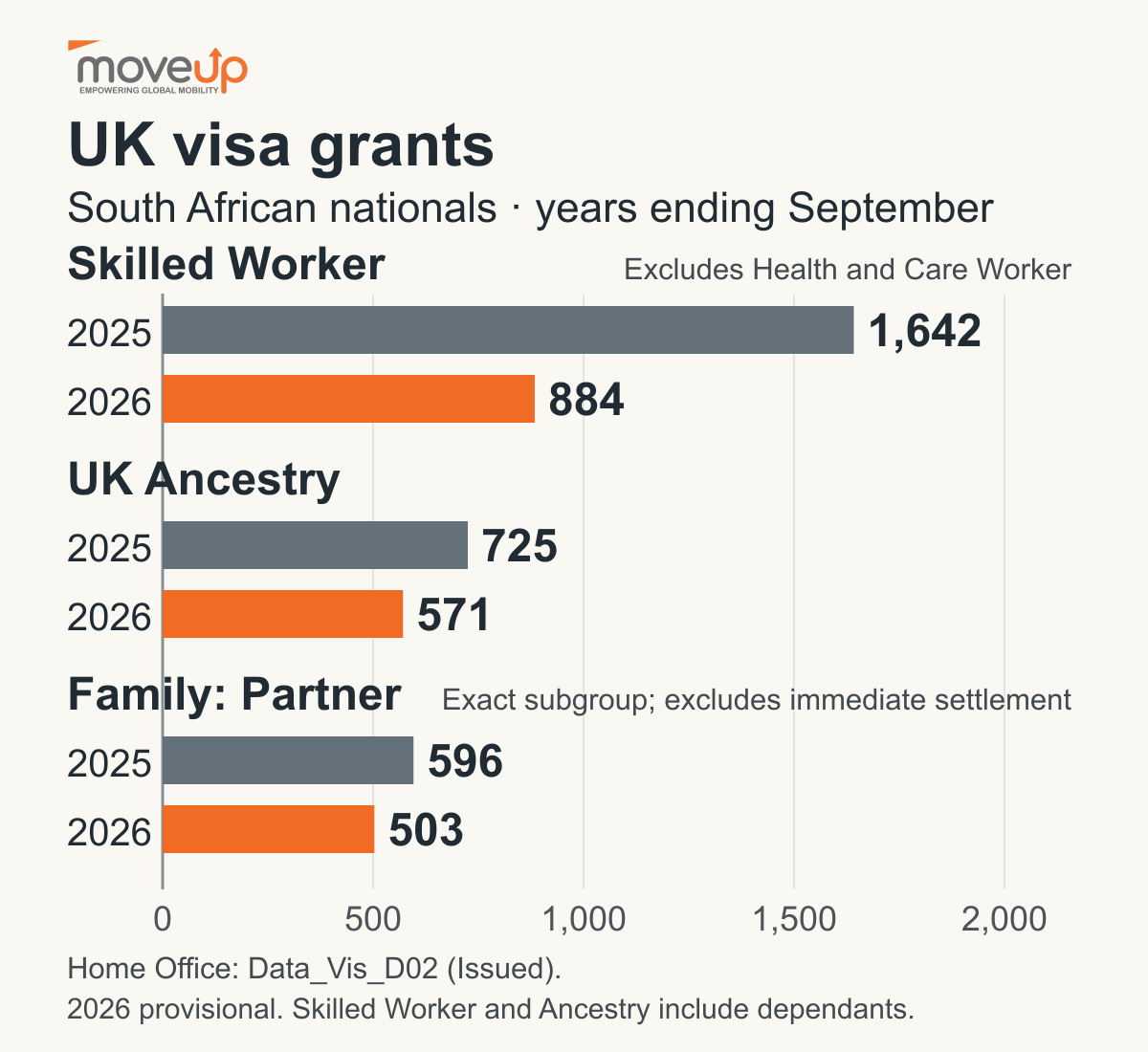
- Skilled Worker grants fell 46%, from 1,642 to 884; Health and Care Worker is excluded.
- UK Ancestry grants fell 21%; the exact Partner subgroup fell 16%. These are three selected routes, not all UK visas.
- Applications also fell, but these period counts do not establish individual chances, arrivals or policy causes.
The number of Skilled Worker entry-clearance visas granted to South African nationals fell from 1,642 to 884 between the years ending September 2025 and September 2026. That is 758 fewer grants, a fall of 46%, for the Skilled Worker subgroup excluding Health and Care Worker.
The Home Office’s new release also records lower grant volumes for UK Ancestry and the exact Family: Partner subgroup. These are changes in the numbers of visas issued across three selected routes. They do not tell you how likely your own application is to succeed.
Three routes, three different changes
Skilled Worker: grants fell by 46%, from 1,642 to 884. Both parts of the total decreased: main-applicant grants went from 957 to 467, and dependant grants from 685 to 417. These figures exclude Health and Care Worker.
UK Ancestry: grants fell by 21%, from 725 to 571, or 154 fewer grants. Main-applicant grants went from 527 to 409, while dependant grants went from 198 to 162.
Family: Partner: grants fell by 16%, from 596 to 503, or 93 fewer grants. This comparison uses the workbook’s exact Partner subgroup. It excludes the separate Partner subgroup for immediate settlement. The workbook does not split these figures by British versus settled sponsors, and the result is not a measure of all family visas or indefinite leave to remain.
Applications also fell across all three selected routes
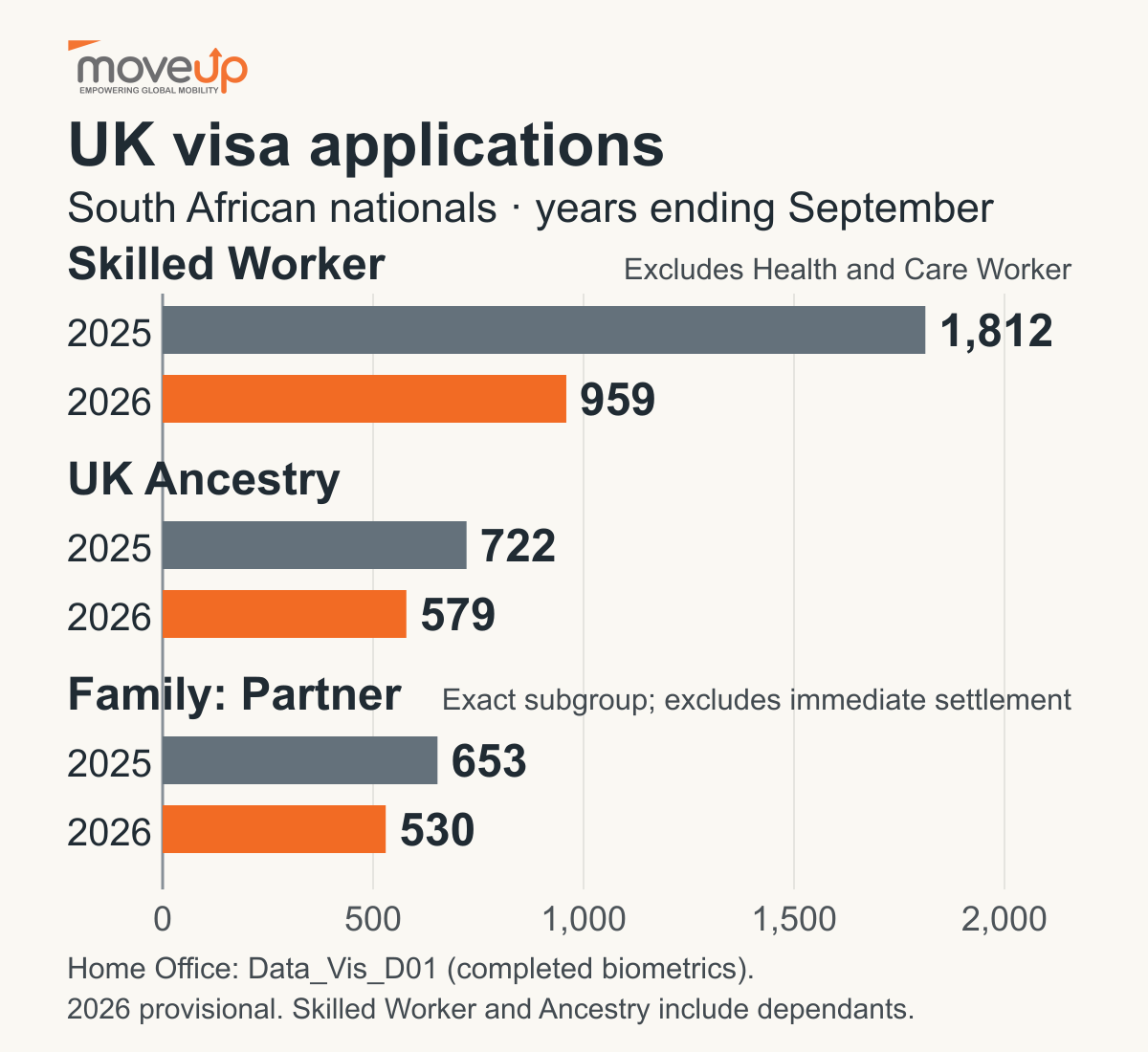
Skilled Worker applications fell from 1,812 to 959, a decrease of 853, or 47%. UK Ancestry applications fell from 722 to 579, down 143, or 20%. Partner applications fell from 653 to 530, down 123, or 19%.
The lower grant totals sit alongside lower application volumes in each of these three selected routes. This comparison does not establish why either measure changed. It cannot isolate the effect of a policy change, processing timing or changes in who applied.
The figures behind the charts
All counts below refer to South African applicant nationality and UK entry clearance. The 2025 window is October 2024 to September 2025; the 2026 window is October 2025 to September 2026. Percentage changes are rounded to the nearest whole percent.
Applications: matched years ending September
| Selected route | 2025 | 2026 |
|---|---|---|
| Skilled Worker, excluding Health and Care Worker | 1,812 | 959 |
| UK Ancestry | 722 | 579 |
| Family: Partner, exact subgroup | 653 | 530 |
Grants: matched years ending September
| Selected route | 2025 | 2026 |
|---|---|---|
| Skilled Worker, excluding Health and Care Worker | 1,642 | 884 |
| UK Ancestry | 725 | 571 |
| Family: Partner, exact subgroup | 596 | 503 |
Skilled Worker and UK Ancestry totals include main applicants and dependants. Family: Partner excludes the separate immediate-settlement subgroup. The grants table counts the outcome Issued.
Why these figures are not approval rates
An application and its decision can fall in different reporting periods. Some grants recorded in one year therefore relate to applications made earlier. Dividing this year’s grants by this year’s applications would not give a cohort approval rate.
The figures also do not count arrivals in the UK or describe an individual applicant’s chances. A smaller number of grants across a route does not change the need to check the requirements that apply to your circumstances. Figures for the 2026 quarters remain provisional and may be revised.
Start with the route that fits your circumstances
If you are planning a move, begin with the basis on which you would apply. Explore Move Up’s UK work-route guidance, UK Ancestry guidance or family-route guidance. These routes ask different questions about your work, family connections and household plans.
Then choose a Move Up assessment for the route you want to explore. The useful first step is to understand which route may fit and what facts need checking before you plan a move.
Your next useful step
Choose a Move Up assessment
Start with the route that may fit your work or family circumstances, then share the relevant facts with Move Up.
Choose a Move Up assessment